Boldoot · Amsterdam · since 1789
Geen fles maar een flacon
Not a bottle, but a flacon
The history of J.C. Boldoot
Boldoot is the Amsterdam house that turned eau de cologne from a pharmacist’s remedy into a household scent. The name became so ordinary that Amsterdammers called the night-soil cart the Boldootkar (Boldoot cart): anything that smelled strongly smelled of Boldoot. Inside the firm nobody ever said fles (bottle). As soon as it carried the name Boldoot, it was a flacon.
Never a fles. Always a flacon.
In Amsterdam since 1789
Our story
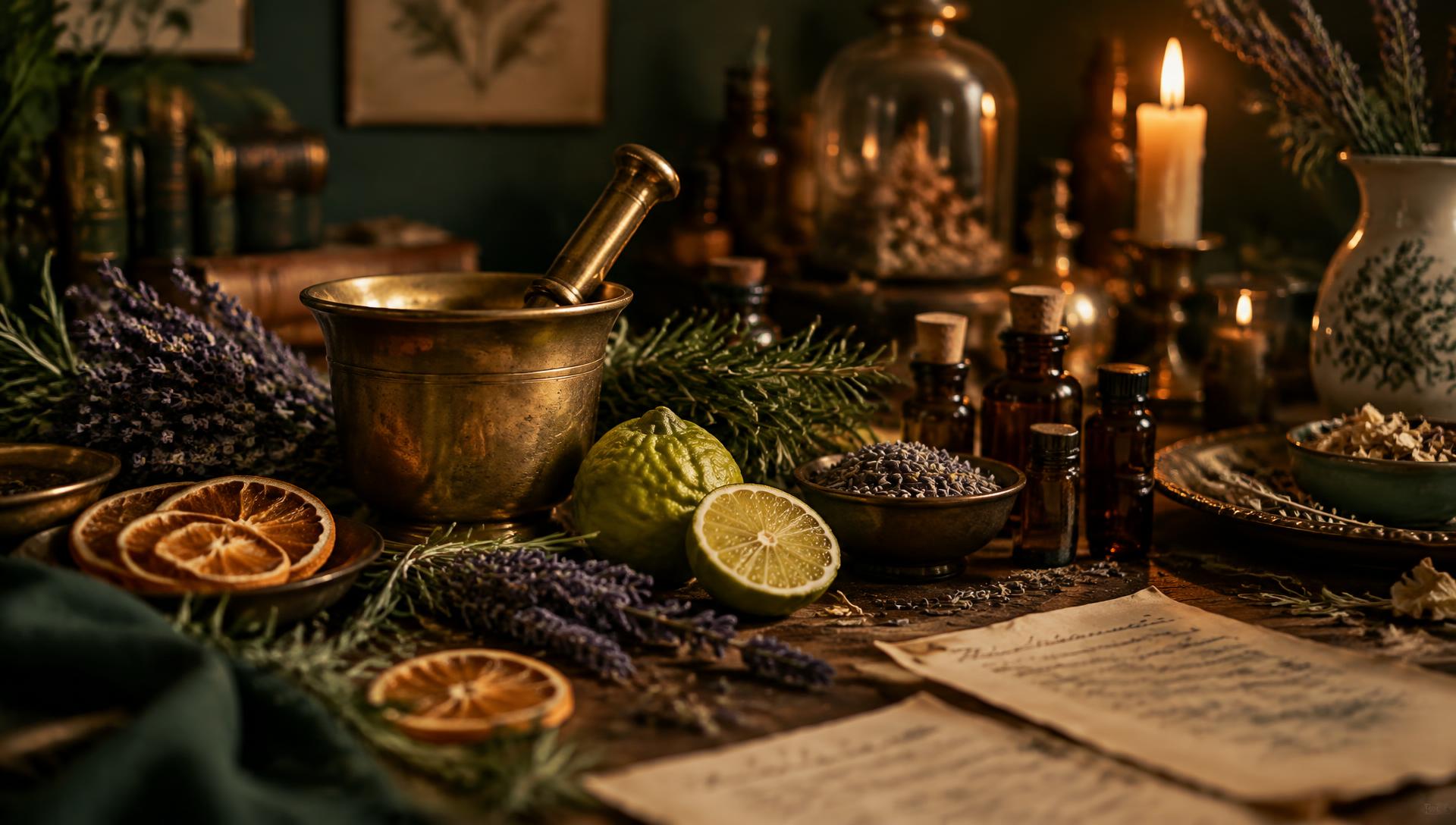
On 1 May 1789, Jacobus Cornelis Boldoot (1766–1838), son of an Old Catholic master carpenter, stood behind his own counter at Nieuwezijds Voorburgwal 46, on the corner of the Korte Kolksteeg. Shop below, living quarters and apprentices above. A mortar weighing 132 pounds, carved with his name and the year 1789, remained the relic of the firm for generations.
In the laboratory behind the shop he prepared powders, salves and an alcoholic “Cologne water” — first against headache and fainting, later more a toilet water than a medicine. His nephew and godson, also Jacobus Cornelis, took over in 1834 and turned the shop into a chemical and cosmetic works; around 1865 production moved to Singel 92.
His son Joannes Jacobus bought the old house of Johann Maria Farina on the Sternengasse in Cologne in November 1875, with the rights to the name eau de cologne and sight of the recipes. Boldoot became purveyor to the courts of the Netherlands, Belgium, Spain, Portugal and Italy, with offices from Brussels to London and connections as far as Shanghai and the Dutch East Indies.
“4711 is good, but Boldoot is better.”
From pharmacist's remedy to household fragrance
The craft
Classic eau de cologne is light and alcoholic, with rosemary, orange blossom and citrus. For generations it passed as a stimulating cordial — taken inwardly and applied outwardly. In the nineteenth century the medical claim faded and Boldoot sold freshness; mechanisation made it cheap enough for almost everyone. The elite turned up their noses. Boldoot did not mind.
Van winckel tot multinational
From winckel to multinational
On 1 May 1789 the twenty-three-year-old Jacobus Cornelis Boldoot (Amsterdam 1766 – Driebergen 1838) opened his pharmacy at Nieuwezijds Voorburgwal 46, corner of the Korte Kolksteeg. He had inherited the house from his father, master carpenter Hendrik Ambrosius Boldoot. Downstairs was the winckel (shop); upstairs lived the family and the apprentices.
The family was oud-katholiek (Old Catholic); the children were baptised in the hidden church De Ooievaar (The Stork) in the Barndesteeg. On 27 June 1780, at fourteen, Jacobus was registered as apprentice artsenijmenger (apothecary’s assistant) with pharmacist Jean George Riga. In March 1789 he sat his meesterproef (master’s examination). The shop sold everything physicians prescribed: powders, ointments, pills — and an alcoholic medicinaal water (medicinal water) that would later be called Keuls water, odeklonje, or eau de cologne.
It was said to clear the mind and strengthen the body. People dabbed it for headache and fainting, poured it into bathwater, and in the eighteenth century still drank it in wine or broth. Only in the nineteenth century did the claim shift from medicine to freshness.
Jacobus was the son of Hendrik Ambrosius Boldoot (1739–1789) and Anna Voet. His apprenticeship with Riga was in the Langebrugsteeg. When the guild allowed him to open his shop in 1789, a mortar weighing 132 pounds was carved with his name and the year; it later became a relic of the firm.
On 15 July 1790 he married Maria Hillenaar of Dordrecht. The marriage remained childless. In the laboratory behind the shop he prepared powders, salves and Cologne water. In 1823 he took his nephew and godson into the business; the will of 1830 allowed that nephew to take over the pharmacy for 4,000 guilders, though some sources give 2,000.
Drie Boldoots
Three Boldoots
- Jacobus Cornelis Boldoot (1766–1838) — Founder. Childless. By a will of 13 May 1830 his nephew and godson — also named Jacobus Cornelis — was allowed to take over the pharmacy.
- Jacobus Cornelis Boldoot (1809–1876) — Son of Johannes Ambrosius Boldoot and Elisabeth Anna van Vlijmen. He married Helena Maria Thijssens in 1834; they had three daughters and, in 1850, a son. He took over on 1 January 1834 and shifted the firm from medicines toward cosmetic chemistry, varnishes and scented water. After a still helmet blew off and the house nearly burned, the city in 1844 licensed further experiments on a yard in the Sint-Jacobsstraat. In 1848 the firm also supplied illuminating gas for street lighting. Around 1865 the chemical works moved to Singel 92. He assembled a specialist scientific library, styled himself apotheker en alcoholische vernisfabrikant (pharmacist and manufacturer of alcoholic varnishes), and launched Eau Admirable. He died on 31 March 1876, six months after the Cologne purchase.
- Joannes Jacobus Boldoot (1850–1898) — Only son. Educated abroad and made a partner in 1871 after coming of age by Royal Decree, he married Maria Regina Desmons in 1873. Export-minded and brand-conscious, he bought Singel 90 and Langestraat 49, 51 and 53. Around 1885 he built the villa Courbe Voie in Baarn, possibly designed by N. Redeker Bisdom in neo-Renaissance style; Pope Leo XIII made him a Knight of the Order of St Gregory. On 28 June 1898 he rode out in the woods near Baarn. The horse came home alone. His body was found near the railway bridge, and he was buried at St Barbara. With him the male Boldoot line ended. Relatives continued the business — in practice the Van Vlijmen family.
On 15 May 1899 the company became the N.V. Eau de Colognefabriek voorheen J.C. Boldoot (Eau de Cologne Factory formerly J.C. Boldoot Ltd).
De koop in Keulen, 1875
The Cologne purchase, 1875
Eau de cologne comes from Cologne. Early in the eighteenth century Giovanni Paolo Feminis put a herbal and citrus water on the market as Aqua Mirabilis. Giovanni Maria Farina made the name famous. Later Cologne counted dozens of firms called Farina. 4711 of the Mülhens family is a different house.
Boldoot did not buy 4711, and did not buy Farina gegenüber dem Jülichs-Platz. It bought the older firm Johann Maria Farina at Sternengasse 9–11, from Felix Werres and Antonia Lützeler. On 5 November 1875 J.J. Boldoot signed the transfer before Prussian notary Karel Joseph Koch. On 16 December 1875 he brought the Cologne firm into the partnership J.C. Boldoot.
“Moe en wanhopig stuur ik u deze weinige regelen. Vermoeid doordat ik de geheele dag door de morsige vuile straten der stad K. gebaggerd heb […]. Ik geloof nooit dat wij aan een reëele farina komen, zonder colossaal grote kosten en nog meer moeite.”
— Tired and desperate I send you these few lines. Worn out from wading all day through the filthy streets of the city of K. […] I never believe we shall come by a genuine Farina without colossal cost and still more trouble.
Letter from son to father, 20 October 1875
Amsterdam gained the recipes and the right to the name eau de cologne — Keuls water (Cologne water). Rival 4711 never forgave it. As late as 1964 the Boldoot board refused to hang a Delft plate that 4711 had commissioned for Boldoot’s 175th anniversary.
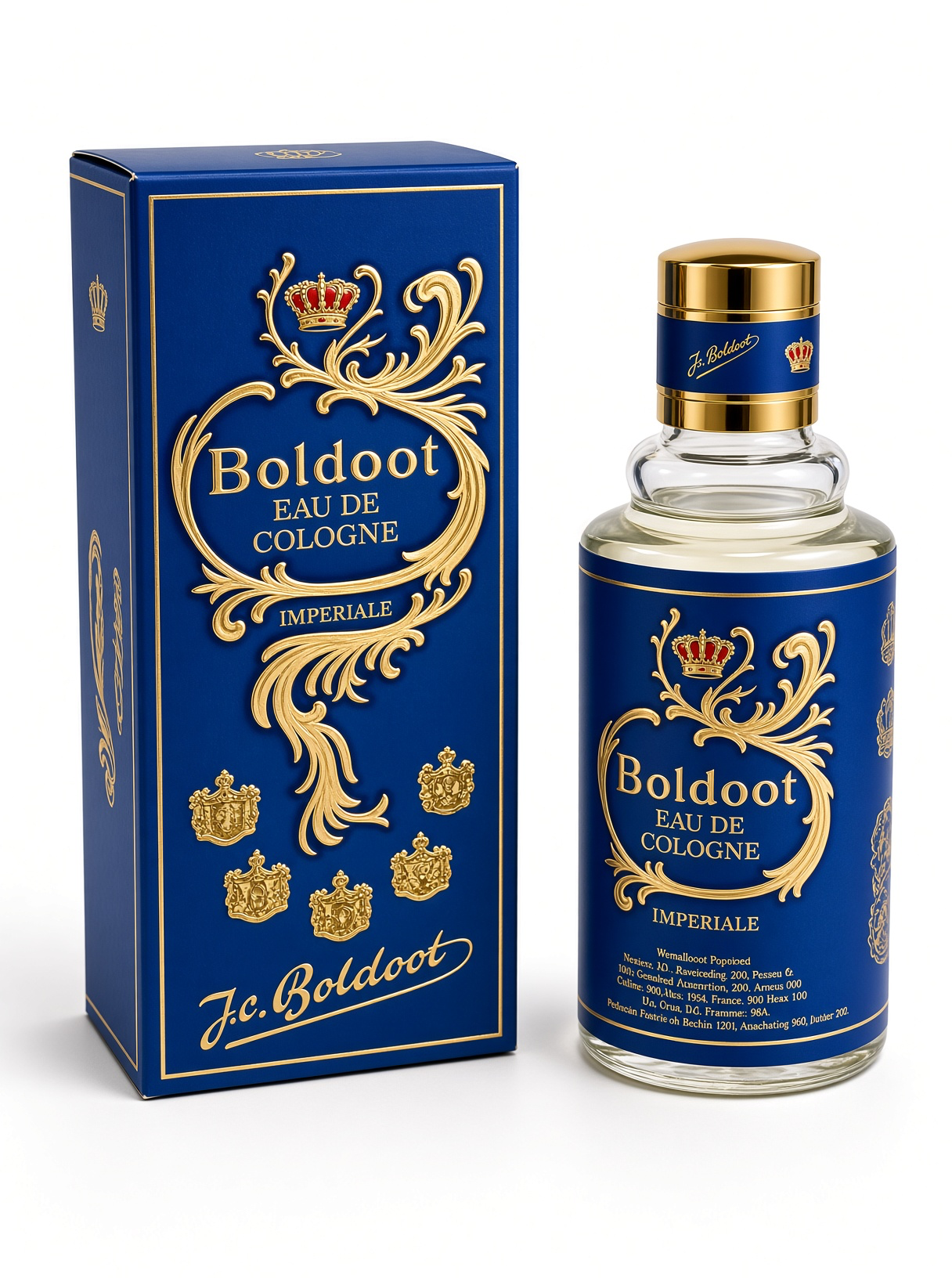
House marks thereafter: Véritable Eau de Cologne as the core line; later the dearer Impériale.
Hofleverancier, tentoonstellingen, zestien panden
Court warrants, exhibitions, sixteen houses
Boldoot became hofleverancier to five courts: the Netherlands, Belgium, Spain, Portugal and Italy. Gold medals at international exhibitions, including Paris, added lustre. Telephone in 1881; a gas engine in 1882.
By 1900 some sixteen properties on the Singel and in the Langestraat were in production. The scent hung over the inner city. In 1902 a soap works rose on the Haarlemmerweg near Sloterdijk. In 1938 the whole firm moved there; Singel 90–96 were sold. Later memory put as many as 1,500 people on the payroll.
The range was wide: eau de cologne, soap (from 1876), tooth powder and mouthwash (first imagined as Odol, then Pastol), creams, lacquers, varnishes — even scented hoedenlak (hat lacquer) for women whose pastor banned odeklonje from the pulpit.
Offices or branches followed in Brussels, Cologne, Paris and London, with ties as far as New York, Shanghai and Nederlands-Indië (the Dutch East Indies).
The Amsterdam works had expanded first from Nieuwezijds Voorburgwal through to the Nieuwezijds Achterburgwal, later the Spuistraat, and then to the Singel complex. The First World War brought shortages of raw materials; prosperity and a chain of Boldoot shops followed. Depression and the Second World War broke the company. In 1942 the N.V. was liquidated and continued as a limited partnership; after the war it recovered, returned to company form and widened again into toothpaste and cosmetics.
Geen fles maar een flacon
Not a bottle, but a flacon
Cosmetic bottles were always a class apart: made for single use, while milk and wine bottles were washed and reused. Even so, almost every drogist (chemist) kept a refill jar on the counter. Empty Boldoot flacons went back to the shop — or to the dump, from which collectors later dug them up. Glass lasts.
At Boldoot the word fles was not to pass anyone’s lips. A bottle that bore the name Boldoot was a flacon. It meant the same thing and sounded far smarter. Advertising used the word without exception.
Forms included clear-white molano’s and kropmolano’s; long-necked green bottles (later echoed in the Conimex soy-sauce bottle, 1948); tubular medicine vials; 1930s Delfts blauw (Delft blue) earthenware; and figure bottles — mills, orphan girls, members of the House of Orange.
Closures moved from a pierced cork with a tin sprinkler to the narrow sprenkelmonding (sprinkle mouth) of no more than 4 mm — for excise law — and the two-part nickel Hermeta cap.
Glass came from Maastricht, Meursing in Nieuw Buinen, Belgium and France. Leerdam seems never to have made molano’s for Boldoot. Wartime shortages produced half-white bottles.
For well-to-do women: cut crystal or half-crystal flacons, sometimes with gold initials — the true loddereintjes, from the folk corruption of l’Eau de la Reine. Cheaper purse or church vials, refilled with a tiny funnel, were wrongly given the same name.
Royal bottles belonged to the house: Wilhelmina as a child (1884) and later; Prince Hendrik (1902); the silver-jubilee bottle of 1923; Juliana as figure and as soap (1913); a Juliana flacon in 1979. Some caps were little tin crowns.
In ’t Geurige Rooske
In the Fragrant Little Rose
Smart trade went through own shops: the Passage in The Hague, the Nieuwendijk, the Kalverstraat. Ladies had their coach stop at the Singel without stepping down; staff ran back and forth until Madame had chosen.
The flagship was In ’t Geurige Rooske (In the Fragrant Little Rose), Kalverstraat 96, beside the entrance to the Burgerweeshuis (Civic Orphanage) — hence the orphan boys and girls on bottles. In 1918–1919 architect Jordanus Roodenburgh gave the shop a new front: mahogany, stained glass by Willem Bogtman, painting by Mathieu and Jan Wiegman, gilded putti with roses by Jan Christoffel Schultsz. The façade is a listed monument. The interior is gone. The name in the shopfront, the Art Deco lamp and the bronze ornament survive.
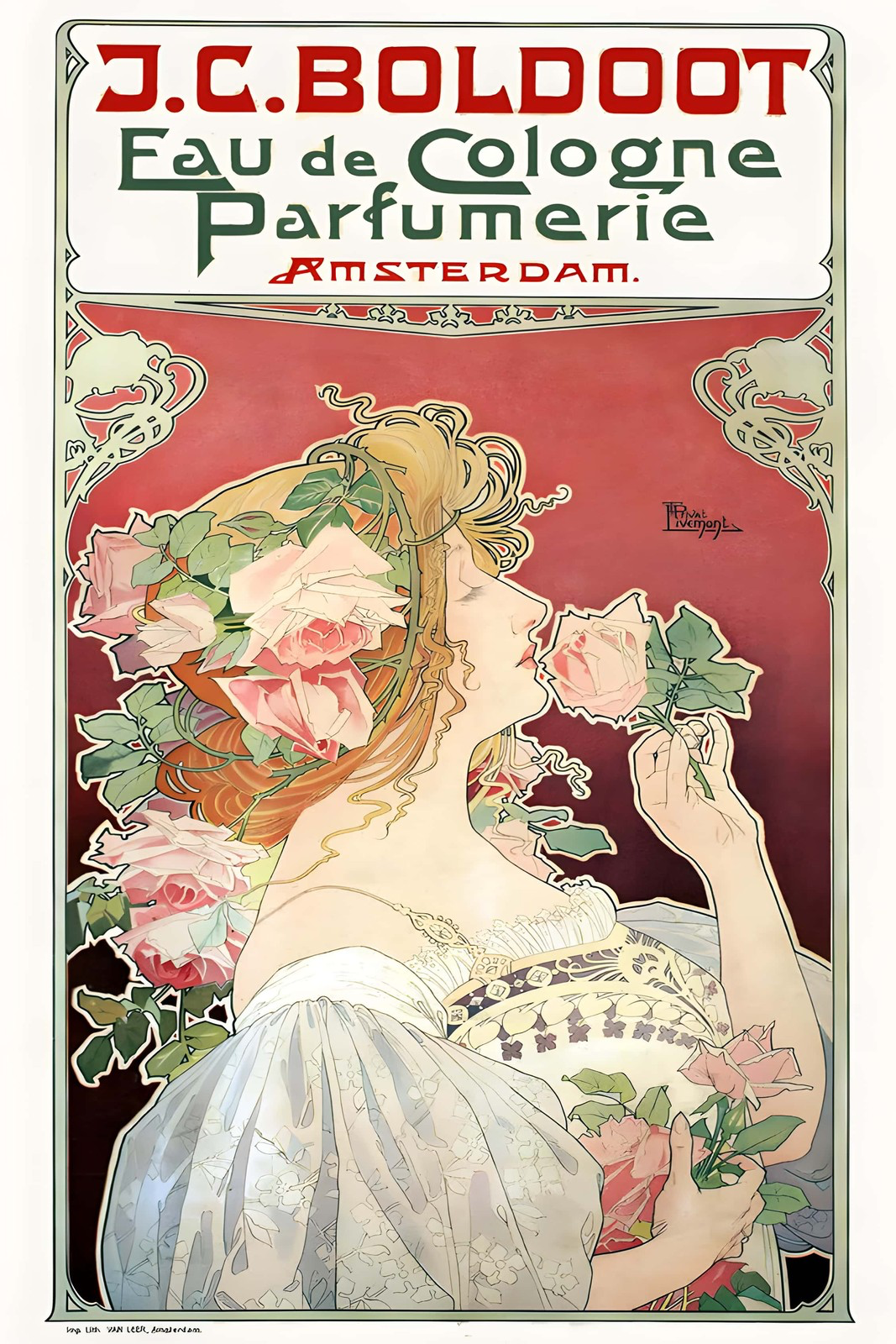
In 1899 the Belgian Art Nouveau artist Henri Privat-Livemont drew the famous Boldoot poster: a woman in roses, no bottle in sight. It remains the house’s strongest image.
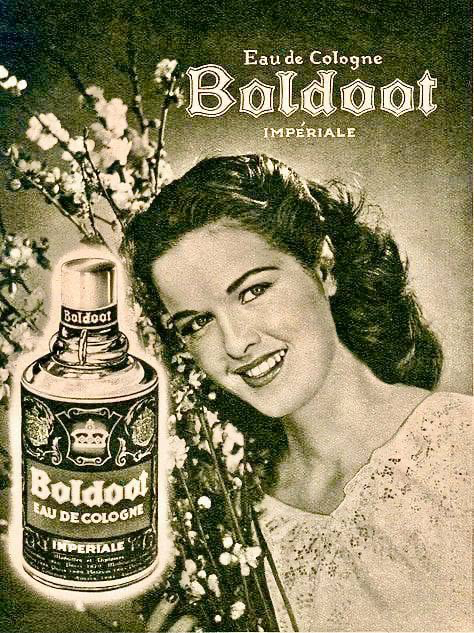
Advertising stayed well clear of the washtub and the public baths. It showed civilised, sporty people, film stars and women among flowers. Window cards mattered while the counter still stood between customer and product. After the war Frans Mettes designed, among other things, the St Nicholas cartons that appeared in every chemist’s window from early November.
It was said that a clerk poured a flacon of Boldoot over the Kalverstraat pavement each morning to draw people in. Under German occupation another line went round Amsterdam: ‘4711 is good, but Boldoot is better.’
Volksparfum
A scent for ordinary people
Classic eau de cologne was light and alcoholic, with rosemary, orange blossom and citrus. For generations it passed as a stimulating cordial — taken inwardly and applied outwardly, even in childbirth. As its medical claims faded, mechanisation made freshness affordable to almost everyone. The elite might turn up their noses; Boldoot did not mind.
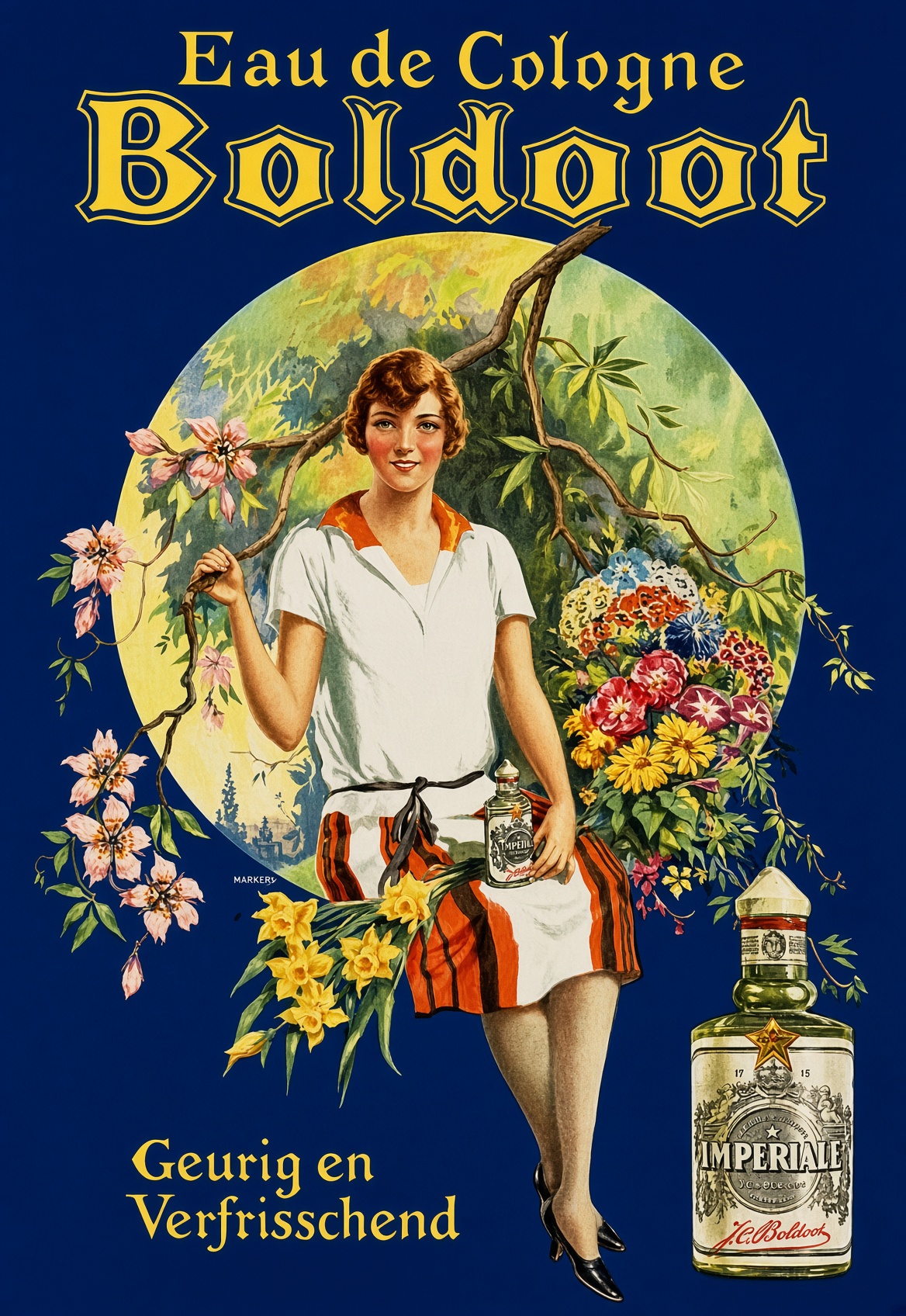
Well into the twentieth century eau de cologne was everyday. Bathrooms were a luxury; people washed in the tub or at the bathhouse. Boldoot sold sizes up to a litre. In practice it was parfum der armen (the poor man’s perfume), opoe-water (granny’s water), keukenmeidenparfum (the kitchen-maid’s scent) — and at the same time purveyor to five courts.
IJs Eau de Cologne with menthol was made for chronic headache. The night wagon that emptied the privy tubs was, in Amsterdam, the Boldootwagen. To say Boldoot was to think of a sickroom or of church.
That chemist’s-shop image later became a burden. Image brands such as Lérys (Paris, for America) and the men’s line Boldon never quite lifted Boldoot off the refill bottle on the counter.
Neergang en nalatenschap
Decline and afterlife
In 1961–1963 the family firm passed to Koninklijke Zwanenberg-Organon (later Akzo), mainly for its skill with creams — Zwitsal was bought at the same time. Hormone creams failed. Production moved to Haarlem and Apeldoorn. The vast range of shapes, sizes and gold-dust labels (printable only in Germany) grew too expensive.
Joannes Maria Bernardus ‘Thijs’ van Vlijmen directed Koninklijke Boldoot from 1954 to 1966. In the 1970s production moved to Haarlem and Apeldoorn, where Aerofako took part in manufacture.
Then: British American Cosmetics (1984), Douwe Egberts / Sara Lee (1987), later among others Coty. The products slowly left the shelves.
In 2002 Coty offered leftover material to the Nederlands Parfumflessen Museum (Dutch Perfume Bottle Museum) in Winkel, North Holland. Conservator Carina van Zoonen spent more than a year sorting flacons, posters, catalogues, soap stamps and photographs from containers in Haarlem. A 2004 exhibition set attendance records. That museum closed in 2017; parts of the collection went to collectors and sales. The Boldoot–Van Vlijmen family and company papers are in the Stadsarchief Amsterdam (Amsterdam City Archives), access 734.
Around 2007–2009 reports said a descendant had bought the brand back from Coty. Whether and how the mark is active now differs by source.
Timeline
- 1766
- Birth of Jacobus Cornelis Boldoot
- 1780
- Apprenticed to J.G. Riga
- 1 May 1789
- Pharmacy opens, NZ Voorburgwal 46
- 15 Jul 1790
- Marriage to Maria Hillenaar
- 1823
- Nephew J.C. Boldoot (1809) enters the shop
- 1 Jan 1834
- Nephew takes over
- 1838
- Founder dies
- 1844
- Experiments licensed, Sint-Jacobsstraat
- 1848
- Firm supplies gas for street lighting
- c. 1865
- Works move to Singel 92
- 1871
- J.J. Boldoot becomes partner
- 5 Nov 1875
- Purchase of Johann Maria Farina, Sternengasse 9–11
- 31 Mar 1876
- Death of the second J.C. Boldoot
- 1876
- Eau de cologne in soap
- 1881–1882
- Telephone; gas engine; court warrants
- c. 1885
- Villa Courbe Voie built in Baarn
- 28 Jun 1898
- J.J. Boldoot killed in a riding accident
- 15 May 1899
- N.V. Eau de Colognefabriek v/h J.C. Boldoot
- 1899
- Privat-Livemont poster
- 1902
- Soap factory, Haarlemmerweg / Sloterdijk
- 1918–1919
- Front of In ’t Geurige Rooske, Kalverstraat 96
- 1938
- Final move from the Singel
- 1942
- N.V. liquidated; continued as a partnership
- 1954–1966
- Thijs van Vlijmen directs Koninklijke Boldoot
- 1961–63
- Organon / Akzo
- 1970s
- Production moves to Haarlem and Apeldoorn
- 1984 / 1987
- British American Cosmetics; Sara Lee; later Coty
- 2004
- Boldoot exhibition, museum in Winkel
- c. 2007
- Reported return of the brand rights to a Van Vlijmen descendant
What Boldoot was
Closing essay
Three strands run together.
Family. An Old Catholic carpenter’s son becomes a pharmacist. A childless founder. A nephew who turns the winckel into a factory. A son who buys the recipes in Cologne and falls from his horse in the woods at Baarn. After that, no Boldoot men — Van Vlijmen instead.
Company. From a guild pharmacy to an early industrial multinational: sixteen inner-city houses, a Sloterdijk soap works, royal warrants, and a century of mergers.
Brand. Cologne water that became Dutch. First against headache, then for the Sunday collar and the kitchen drawer. Bottles as Orange souvenirs, an Art Nouveau woman in roses, a mahogany shopfront on the Kalverstraat, and a scent so taken for granted that the night-soil cart was named after it.
That is Boldoot: not the finest perfume in Europe, but the water with which Amsterdam made itself recognisable.
Nooit een fles. Altijd een flacon.Never a bottle. Always a flacon.